
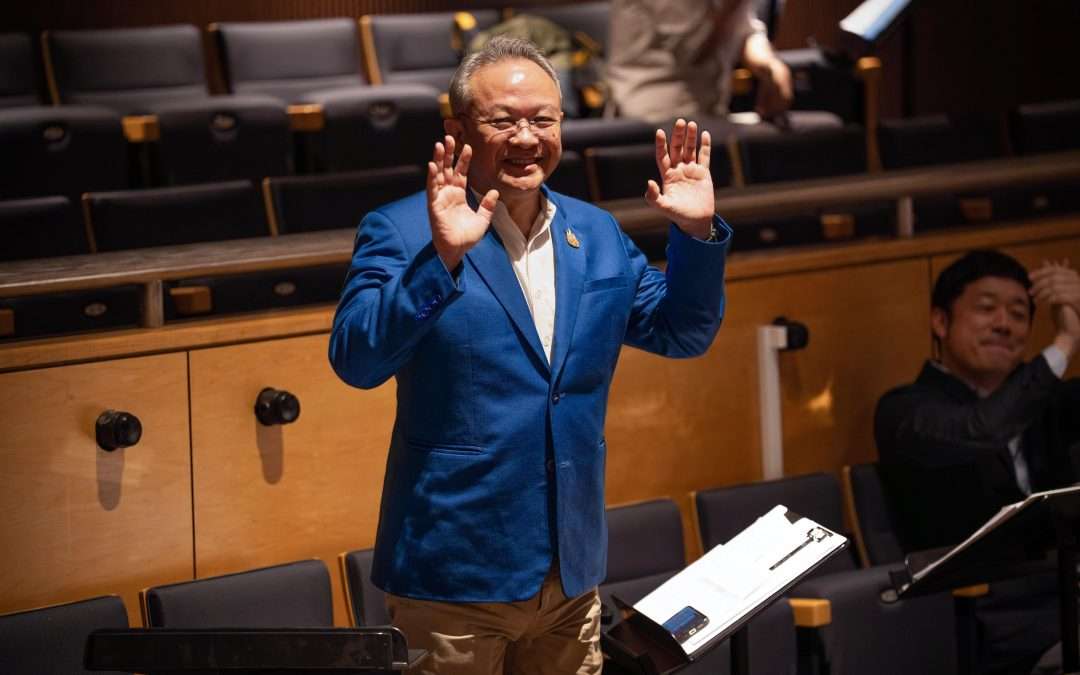
An Interview with Dr Nipat Kanchanahud
On Rehearsal Philosophy, Listening, Wind Band Education, and Leadership
In the world of wind band education, few educators have influenced Southeast Asia as profoundly as Dr Nipat Kanchanahud. As a conductor, educator, adjudicator, and professor at Kasetsart University, he has spent decades shaping generations of musicians and band directors while championing a philosophy that places listening at the heart of music-making.
In this interview, Dr Nipat shares his thoughts on rehearsal effectiveness, score study, ensemble listening, repertoire selection, and the evolving role of the modern band director. Drawing from his experiences at the University of North Texas, his work with Kasetsart Winds, and his continued research into immersive ensemble training, he offers practical insights that challenge many conventional approaches to band rehearsals.
More than a discussion about conducting techniques, this conversation explores the deeper purpose of music education: developing musicians who listen, think, collaborate, and grow together through the ensemble experience. Whether you are a student conductor, experienced educator, performer, or administrator, Dr Nipat’s reflections provide valuable perspectives on building stronger ensembles and fostering meaningful musical development.
TBP: What is something most band directors are doing wrong in rehearsal but do not realise?
Nipat: First of all, conductors need to understand the true goal of a rehearsal. The ultimate purpose of a rehearsal is to create what I call a “musician-listener.”
A musician should not only know their own part; they should also understand what everyone else is playing. The conductor has access to the full score and can see every instrument and every musical line, whereas the musicians only have their individual parts.
The composer’s intentions are written in the score as a form of code. The conductor’s responsibility is to decode that information and transform it into inner hearing – a complete sound image in the conductor’s mind. Once the conductor has that sound image, they bring it into the rehearsal and help the ensemble turn that inner hearing into physical sound.
Unfortunately, many conductors do not do this. They simply read through the music and fix mistakes as they appear. That is not a rehearsal.
I often tell my students: “Do not practice during rehearsal. Practice before rehearsal.”
Rehearsal should be a place where musicians learn to listen to one another. They should understand how their part fits into the whole ensemble. That is the real goal of rehearsal.
TBP: So you’re saying that high school band directors are very important in expanding the ecosystem as a whole?
Nipat: Absolutely. Without them, I would have to work much harder at the university level. The reason I emphasize good band directors is that they prepare students to be in good shape. They provide strong fundamentals and ensure students are ready to develop further.
If a band director only prepares students for a single competition, and those students develop bad habits or poor muscle memory, it becomes very difficult for me to correct those habits later.
It takes time. Good band directors prepare students so that they are ready for major improvements and continued growth. That is why I always feel a great sense of gratitude toward school band directors.
TBP: If you walked into a rehearsal and only had ten minutes with a band, what would you focus on first?
Nipat: I would make sure the musicians experience the entire structure of the piece. If I only had ten minutes with a five-minute march, I would want them to play through every note and understand the overall shape of the music.
I believe students should encounter every note several times before a performance. This follows a spiral learning process where each encounter deepens understanding and reinforces learning.
TBP: Kasetsart Winds has often been described as a wind band laboratory. What are some of the most interesting discoveries you have made through that ensemble?
Nipat: I have been very fortunate to have the right students at Kasetsart University; meaning, students who are open-minded and willing to learn.
Kasetsart Winds functions as a laboratory. Performance majors learn ensemble playing. Composition students can hear their music performed and revise their ideas. Technology and engineering students can experiment with recording techniques and sound design. Conducting students have an ensemble through which they can develop their rehearsal and listening skills.
Listening remains the most important skill. Students must learn to hear not only themselves, but also the other parts around them. Conductors must also develop the ability to listen for what I call the sonic of the ensemble – the total blend of timbre and colour when all instruments combine.
This goes back to the first question. Many conductors miss the importance of listening. Students need to learn to listen to the other parts around them, and conductors must develop their ears to listen for a good sonic result. I don’t just say “sound.” When all the timbres blend together, we call that the sonic of the ensemble.
Kasetsart Winds is a wonderful laboratory where everyone can experiment. Whenever students achieve a certain level of technique, we can go beyond technique and begin exploring new ideas.
That is why I say I am fortunate to have appropriate students. The reason I use the word appropriate is that they are willing to open their minds and experience new things with me. Sometimes you have very talented students, but they are not open. They only want to focus on themselves or play solo repertoire.
Many of my students are not necessarily the strongest in their first year. But by their second year, they improve significantly, and by their third year, they become some of our best students. Most of my students follow that pattern. When they first enter the university, they often feel uncomfortable because they are coming directly from high school.
Fortunately, I have strong relationships with many high school band directors. They prepare their students very well before they arrive at Kasetsart. Many students come from excellent band programs and fit into the university environment very naturally. Their directors prepare them not only musically, but also mentally. They teach students to keep an open mind and continue learning through music.
TBP: What are some important functions of the Harmony Director that conductors and musicians often overlook?
Nipat: The biggest advantage is that it dramatically shortens the time needed to develop listening skills.
I have recently been developing a concept called Immersive Ensemble Training. The Harmony Director is an important part of that process because it was designed specifically to develop listening.
Students do not have time during a performance to think analytically about every harmonic function. Instead, they must develop instinctive listening. They must feel when a chord is correct. When students repeatedly experience beautiful harmonic resonance, they memorize that feeling and eventually adjust automatically without conscious calculation.
What I realized is that the tone colour produced by the Harmony Director is extremely clear. The harmonic series is very clean, and students can feel it. When they become immersed in that environment, they begin hearing the harmonic series at a very deep level. Anything that allows students to hear deeply into the structure of sound helps them build a better ensemble sound. The important thing is that students must not only understand it intellectually; they must feel it.
You can tell a student: “You are playing the third of the chord,” “You are playing the fifth of the chord,” or “You should lower the pitch by thirteen cents.” But during a performance, there is no time to think about those things. You cannot stop and calculate. Instead, the ear becomes a sensor. The body remembers the feeling. When students repeatedly experience beautiful resonance and correct intonation, that feeling becomes part of their long-term memory. When something sounds wrong, they can automatically adjust by instinct.
That is one of the greatest educational benefits of the Harmony Director.
TBP: In terms of rehearsal efficiency, what do conductors waste the most time on?
Nipat: Repeating mistakes without having a clear inner hearing.
Before entering a rehearsal, the conductor should already have completed their personal study. The final result of score study should be a clear sound image in the conductor’s mind. If the conductor enters a rehearsal without knowing what they want to hear, they simply beat time and react to mistakes. That wastes valuable rehearsal time.
TBP: How important is repertoire selection, and how should conductors balance content versus execution?
Nipat: A band director is not only a conductor. A band director must also be a teacher, administrator, educator, and leader.
The ideal repertoire stretches students beyond their current level. It challenges them enough to stimulate growth while remaining achievable. Finding that balance is one of the most important responsibilities of a band director.
Most importantly, you have to know your students.
Selecting repertoire is like cooking. When you cook, you need to know the ingredients you have. You need to know what kind of food you want to make, and you need to know who is going to eat it. If someone cannot eat spicy food, you cannot make everything spicy. If someone is allergic to seafood, you cannot ignore that.
As a band director, you must analyze your students in the same way. You must know what skills they currently have and what skills they need to develop. Then, you choose music that is appropriate for them.
If your students are not ready and you choose an extremely difficult Grade 6 work simply because you want to win, you may damage their development. You force them into situations where they do not have the necessary skills, which can create bad habits and frustration. On the other hand, if the music is too easy, they learn nothing, and you have wasted their time. The ideal approach is to choose music that challenges students just enough so that they improve.
From an adjudicator’s perspective, we evaluate both content and achievement. Sometimes a piece is very difficult and the students perform it successfully. That is excellent. Sometimes the piece is easy and the students perform it beautifully. That is also good. But sometimes I look at the students and think, “These students are capable of more.” Perhaps the conductor did not realize that the students could have handled a more challenging piece. That is where content and achievement must be balanced.
TBP: Tell us about your experience at the University of North Texas as a student and how it shaped your philosophy.
Nipat: I chose the University of North Texas because I listened to recordings by Professor Eugene Corporon and David Fisher and was inspired by what I heard.
When I arrived at UNT, I promised myself that I would experience everything possible and bring that knowledge back to Thailand. One of the most valuable aspects of UNT was the variety of ensembles, each presenting different musical and educational challenges.
When you have a passion and then suddenly enter that environment, it is overwhelming. I remember thinking: “Is this really Eugene Corporon? Is this really David Fisher? Is this really the UNT Wind Symphony?” Everything felt unreal.
At that moment, I promised myself that I would experience everything possible and bring those experiences back to Thailand. After returning to Thailand, I spent six years applying and testing what I had learned.
Later, I returned to UNT for doctoral studies to evaluate and refine those ideas further.
TBP: Finally, why did you become a band director?
Nipat: Because of passion.
My musical journey began when my father bought me a melodica. Later, I joined a school band and became part of a generation that helped pioneer modern wind band education in Thailand.
Today, what makes me happiest is not simply performing great music. It is the friendships that music creates. Music is important, but lifelong friendships built through music are even more important.
When I was in Primary 5 and Primary 6, I moved to Bangkok and studied at Wat Suthiwararam School. That was when I joined a band.
At that time, our band was one of the best in Thailand. Maybe it was destiny. I happened to be in the right place at the right time.
One day, a Japanese band director visited our school. We performed for him. Afterward, he gave us a very memorable comment. He joked: “We have brought you a modern tuner from Japan.”
What he really meant was: “You are not playing in tune.”
Everyone laughed, but behind the joke was a very important lesson.
He introduced many ideas that would eventually change wind band education in Thailand: long-tone training, breathing techniques, embouchure development, listening, and sound production.
These concepts were not common in Thailand at that time. That visit had a huge impact on us. My friends and I became fascinated by these ideas.
Looking back now, I think we all became part of the pioneer generation of modern wind band education in Thailand.
Nipat Kanchanahud, D.M.A. is a full-time faculty at Department of Western Music, Faculty of Humanities, Kasetsart University. While he is the Conductor in Residence of Kasetsart University Wind Symphony, Nipat has collaborated with many world-class musicians and composers namely Prof. Boris Berman, famous pianist and professor from Yale University, Dr. Indhuon Srikaranonda a famous pianist from Thailand, Dr.Timothy Thompson, a well known Hornist from University of Arkansas, Jan Van de Roost, and Satoshi Yagisawa.
Dr. Nipat Kanchanahud completed Doctor of Musical Arts degree in Wind conducting performance (D.M.A. Conducting Performance) from University of North Texas, Denton TX, U.S.A. where he was a doctoral conducting associate of North Texas Wind Studies as well as guest conductor of North Texas Wind Symphony, North Texas Symphonic Band, and North Texas Concert band. He was also a graduate teaching fellow of Wind Conducting class of Prof. Eugene M. Corporon and Prof. Dennis W. Fisher. While studying, Nipat has been the drill formation designer of “The Green Brigade” UNT Marching Band since 2004 – 2006, and 2012 – 1015 under the direction of Dr. Nicholas E Williams. In addition, he studied horn with Prof.William Scharnberg and was a horn player of North Texas Wind Symphony. A native of Krabi Province, Dr. Nipat started his music education in Bangkok while in secondary school at Wat Suthiwararam School, one of Thailand’s leading schools for wind band. He grew up in the environment of wind band during his 6 years in secondary school and was selected to be a band – leader for the last two years of his studies.
Dr.Nipat graduated from the Department of Music, Faculty of Fine and Applied Arts Chulalongkorn University with 2nd Class Honors in 1990, where he had a chance for the first time to take conducting class with Associate Professor Dr. Thongsuang Israngkur na Ayudhya, which led him to pursue his future career as one of Thailand’s most prominent wind band conductors and directors. In August 2006 he completed Master of Music degree in Wind conducting (M.M. Wind Conducting) from University of North Texas, Denton TX, U.S.A. where he was a master’s conducting associate at University of North Texas Wind Studies. Having been appointed as a horn player of the Bangkok Symphony Orchestra between 1988- 1995, Dr. Nipat had many opportunities to perform and work with famous conductors and musicians. He passed the audition to participate in the “1st ASEAN Symphonic Band Workshop” in Singapore in April 1992. Later that year he was selected among youth from all Asian countries to participate in the “Asian Youth Orchestra Music Camp and Concert Tours 1992”.
Dr. Nipat is regarded as one of Thailand’s most famous drill formation designers and has conducted workshops on drill design for many occasions In 1998, he was selected to be the Drill Formation Director of the 13th ASIAN GAMES’ opening and closing ceremonies.
In 2011, he was invited to conduct the Wind Ensemble at University of California, Los Angeles (UCLA). While in residence, he worked with music performance and education students in the conducting class. 2012-2015, as a doctoral conducting associate of North Texas Wind Studies, he was a guest conductor of North Texas Wind Symphony, North Texas Symphonic Band, and North Texas Concert band. He was invited to conduct Ohio University Wind Symphony on Spring 2014 Concert and 2015 Summer Concert.
Dr.Nipat Kanchanahud has served as a jury member in many prestigious marching band competitions worldwide. He was one of the jury members of Show Band Competition and Concert Percussion Competition at the World Music Contest 2005, 2009 and in 2017 in Kerkrade, The Netherlands, where he also participated in the 3rd International Round Table Conference at Rolduc Conference Center in July 2005. Moreover, he was invited from the World Association of Marching Show Band to be in the judges panel of the World Marching Show Band Championships throughout the world.
In 1998 and 2008 he was invited by the Ministry of Education of the Republic of Singapore to sit in the panel of judges for “Grand National Marching Band Competition”. Dr.Nipat Kanchanahud was a recipient of the University of North Texas Academic and Graduate Assistantship Tuition Scholarship Award while he was studying his doctoral degree. In addition, he is an honorary member of Phi Mu Alpha music fraternity. He is a sought-after recording, associate producer, and editor, having been involved with numerous CDs and DVDs on the Klavier, Mark Records, GIA, and UNT labels.
In addition to his work in the recording arts, he has written conductor study guides that are published in the Teaching Music Through Performance in Band Series Vol.10 (2015), Middle School (2015), Vol.11 (2017), and Vol.12 (2020) July 2023, as a conductor, he was invited to lead the Kasetsart Winds to performed at Lila Cockrell Theater, in Texas Bandmasters Association (TBA) Convention 2023, San Antonio Texas. He also conducted the clinic in TBA 2023 convention “Winds of Siam: a Cross Cultural Experience for Wind Bands”.
Asyahari Hussaini is a Singapore-based conductor and music educator actively working with wind bands across Southeast Asia. He currently directs school and youth ensembles while pursuing Masters in Music Leadership at the Yong Siew Toh Conservatory of Music. Known for his pedagogical approach blending Dalcroze, Kodály, and modern wind-band methods, he frequently serves as a clinician and adjudicator in regional festivals. Beyond music, he manages operations for SANS Institute in Singapore & Southeast Asia. He continues to champion youth music education and the development of strong community-based wind-band cultures.